Producción Intelectual

Evaluating the effect of nutrient redistribution by animals on the phosphorus cycle of lowland Amazonia
2018·
Articulo

Evaluating the effect of nutrient redistribution by animals on the phosphorus cycle of lowland Amazonia

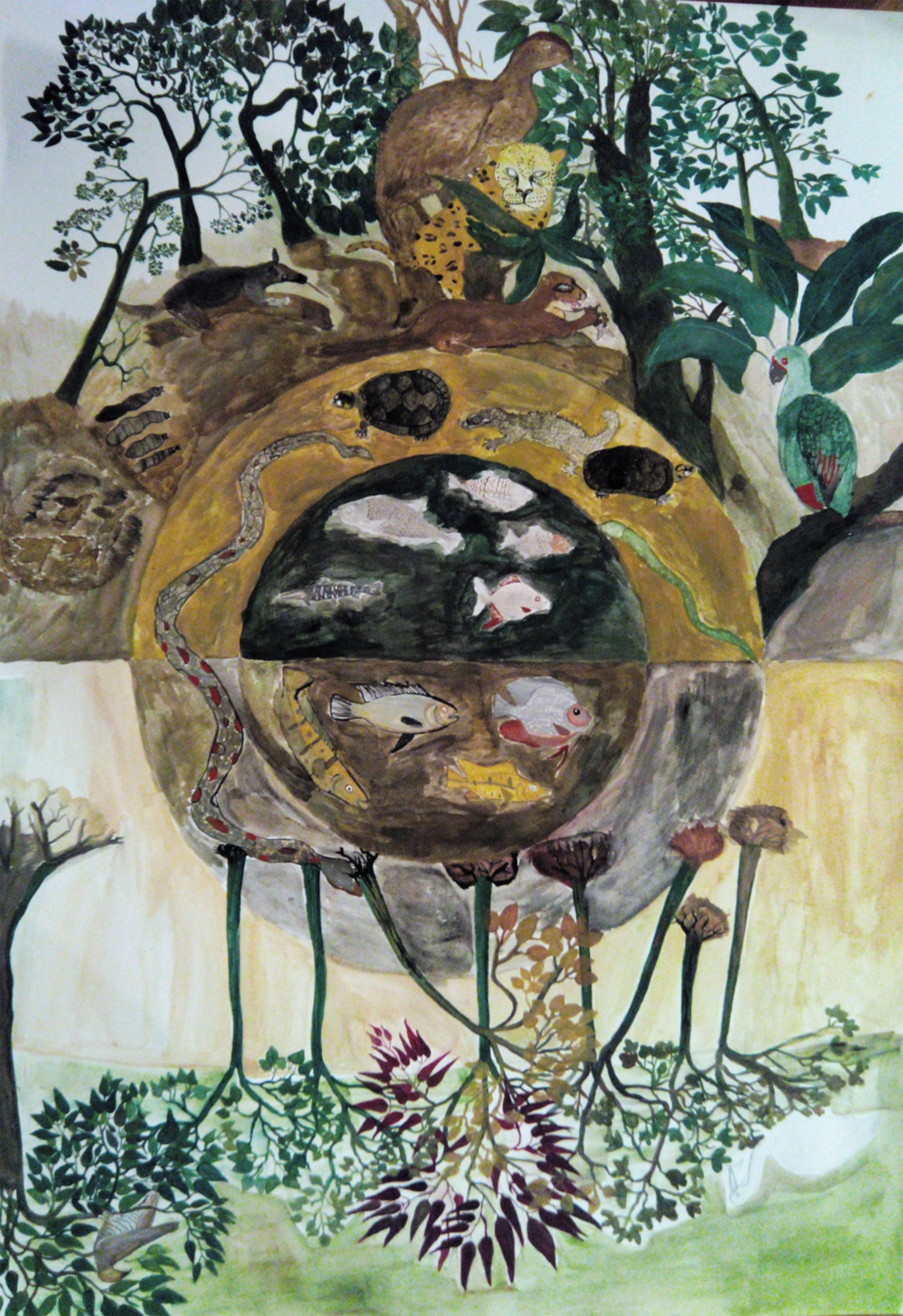
Phosphorus (P) availability decreases with soil age and potentially limits the productivity of ecosystems growing on old and weathered soils. Despite growing on ancient soils, ecosystems of lowland Amazonia are highly productive and are among the most biodiverse on Earth. P eroded and weathered in the Andes is transported by the rivers and deposited in floodplains of the lowland Amazon basin creating hotspots of P fertility. We hypothesize that animals feeding on vegetation and detritus in these hotspots may redistribute P to P-depleted areas, thus contributing to dissipate the P gradient across the landscape. Using a mathematical model, we show that animal-driven spatial redistribution of P from rivers to land and from seasonally flooded to terra firme (upland) ecosystems may sustain the P cycle of Amazonian lowlands. Our results show how P imported to land by terrestrial piscivores in combination with spatial redistribution of herbivores and detritivores can significantly enhance the P content in terra firme ecosystems, thereby highlighting the importance of food webs for the biogeochemical cycling of Amazonia.

Autor(es): Corina Buendia, Bjorn Reu, Axel Kleidon, Stefano Manzoni, Amilcare Porporato
Monitoring ecological change during rapid socio-economic and political transitions: Colombian ecosystems in the post-conflict era
2017·
Articulo

Monitoring ecological change during rapid socio-economic and political transitions: Colombian ecosystems in the post-conflict era

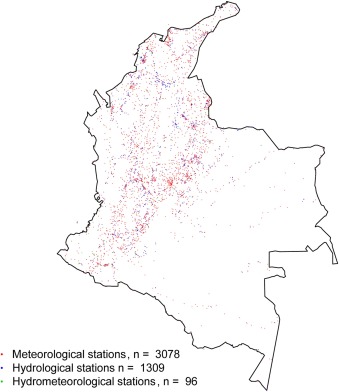
After more than 50-years of armed conflict, Colombia is now transitioning to a more stable social and political climate due to a series of peace agreements between the government and different armed groups. Consequences of these socio-economic and political changes on ecosystems are largely uncertain, but there is growing concern about derived increases in environmental degradation. Here, we review the capacity of Colombia to monitor the state of its ecosystems and their rate of change over time. We found several important programs currently set in place by different institutions as well as by independent groups of scientists that address different aspects of environmental monitoring. However, most of the current initiatives could be improved in terms of data coverage, quality and access, and could be better articulated among each other. We propose a set of activities that would increase the capacity of Colombia to monitor its ecosystems, provide useful information to policy makers, and facilitate scientific research. These include: 1) the establishment of a national center for ecological synthesis that focuses on analyzing existing information; 2) the establishment of an ecological observatory system that collects new information, integrates remote sensing products, and produces near real-time products on key ecological variables; and 3) the creation of new platforms for dialog and action within existing scientific and policy groups.

Autor(es): Bjorn Reu, Carlos A. Sierra, Miguel Mahecha, German Poveda, Victor H Gutierrez-Velez, Catalina Gonzalez Arango, Maria C. Londono Murcia, Rodrigo Jimenez

Predicting biomass of hyperdiverse and structurally complex central Amazonian forests - a virtual approach using extensive field data
2016·
Articulo

Predicting biomass of hyperdiverse and structurally complex central Amazonian forests - a virtual approach using extensive field data

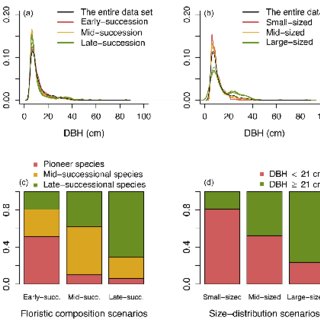
Old-growth forests are subject to substantial changes in structure and species composition due to the intensification of human activities, gradual climate change and extreme weather events. Trees store ca. 90?% of the total aboveground biomass (AGB) in tropical forests and precise tree biomass estimation models are crucial for management and conservation. In the central Amazon, predicting AGB at large spatial scales is a challenging task due to the heterogeneity of successional stages, high tree species diversity and inherent variations in tree allometry and architecture. We parameterized generic AGB estimation models applicable across species and a wide range of structural and compositional variation related to species sorting into height layers as well as frequent natural disturbances. We used 727 trees (diameter at breast height >= 5 cm) from 101 genera and at least 135 species harvested in a contiguous forest near Manaus, Brazil. Sampling from this data set we assembled six scenarios designed to span existing gradients in floristic composition and size distribution in order to select models that best predict AGB at the landscape level across successional gradients. We found that good individual tree model fits do not necessarily translate into reliable predictions of AGB at the landscape level. When predicting AGB (dry mass) over scenarios using our different models and an available pantropical model, we observed systematic biases ranging from -31 % (pantropical) to +39 %, with root-mean-square error (RMSE) values of up to 130 Mg ha?-1 (pantropical). Our first and second best models had both low mean biases (0.8 and 3.9 %, respectively) and RMSE (9.4 and 18.6 Mg ha?-1) when applied over scenarios. Predicting biomass correctly at the landscape level in hyperdiverse and structurally complex tropical forests, especially allowing good performance at the margins of data availability for model construction/calibration, requires the inclusion of predictors that express inherent variations in species architecture. The model of interest should comprise the floristic composition and size-distribution variability of the target forest, implying that even generic global or pantropical biomass estimation models can lead to strong biases. Reliable biomass assessments for the Amazon basin (i.e., secondary forests) still depend on the collection of allometric data at the local/regional scale and forest inventories including species-specific attributes, which are often unavailable or estimated imprecisely in most regions.

Autor(es): Bjorn Reu, Daniel Magnabosco Marra, Susan Trumbore, Gabriel Ribeiro, Niro Higuchi, Joaquim Dos Santos, Jeffrey Q. Chambers, Robinson Negrón-Juárez, Frederic Martin Holzwarth, Adriano Lima, Christian Wirth, Vilany M. C. Carneiro

The global spectrum of plant form and function
2015·
Articulo

The global spectrum of plant form and function

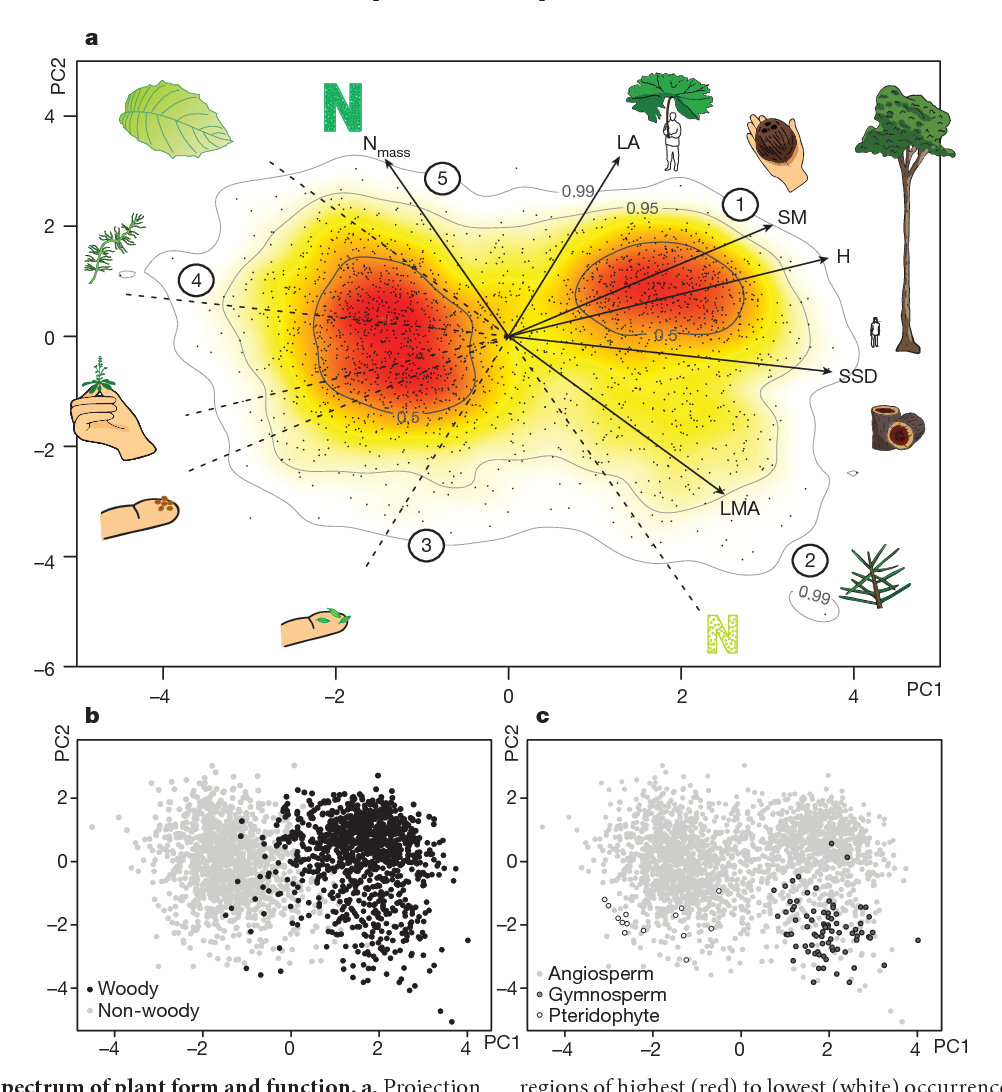
Earth is home to a remarkable diversity of plant forms and life histories, yet comparatively few essential trait combinations have proved evolutionarily viable in today?s terrestrial biosphere. By analysing worldwide variation in six major traits critical to growth, survival and reproduction within the largest sample of vascular plant species ever compiled, we found that occupancy of six-dimensional trait space is strongly concentrated, indicating coordination and trade-offs. Three-quarters of trait variation is captured in a two-dimensional global spectrum of plant form and function. One major dimension within this plane reflects the size of whole plants and their parts; the other represents the leaf economics spectrum, which balances leaf construction costs against growth potential. The global plant trait spectrum provides a backdrop for elucidating constraints on evolution, for functionally qualifying species and ecosystems, and for improving models that predict future vegetation based on continuous variation in plant form and function.

Autor(es): Bjorn Reu, Sandra Diaz, Jens Kattge, Johannes Cornelissen, Ian Wright, Angela Günther , Valeria Falczuk

Morphological and physiological acclimations of coffee seedlings to growth over a range of fixed or changing light supplies
2014·
Articulo

Morphological and physiological acclimations of coffee seedlings to growth over a range of fixed or changing light supplies

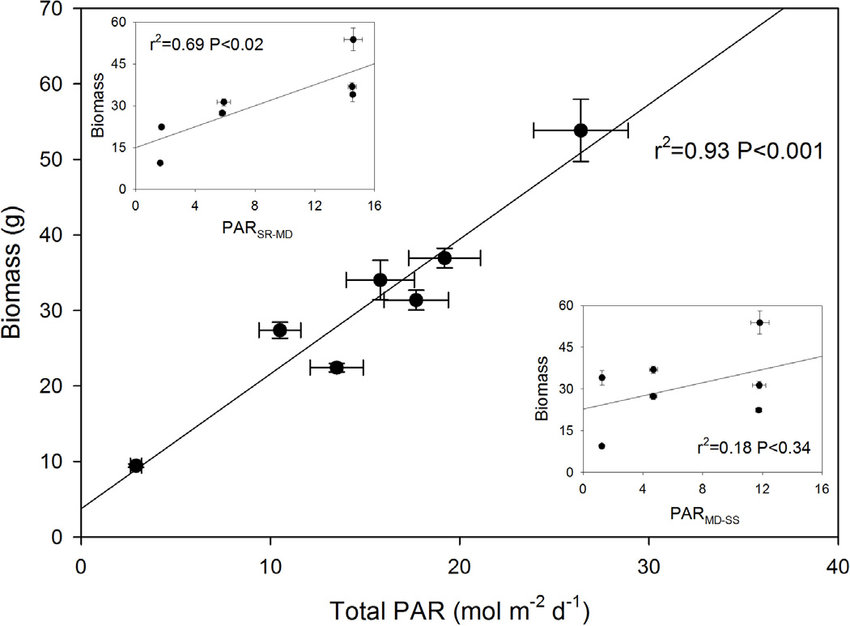
Acclimations to low and high light levels are located in opposite extremes. We examined how the coffee plant (Coffea arabica), which is considered to be shade-demanding although it performs well under full sun exposure, can acclimate to a range of light regimens. We hypothesised that the growth and physiological performance depends on the total amount of light received by the plant per day and on the temporal order of diurnal variations in the light supply. The biomass accumulation and allocation and the key photosynthetic traits of pot-grown coffee seedlings were examined over a range of light treatments as follows: plants grown entirely under 100%, 40% or 10% sunlight; plants grown at either 40% or 10% sunlight from sunrise to midday and then submitted to full sunlight until sunset; and plants grown under full sunlight from sunrise to midday and then submitted to either 40% or 10% sunlight throughout the afternoon. The total biomass increased linearly with the increasing total light supply; however, plants receiving high amounts of light in the morning grew more than those receiving high amounts of light in the afternoon. Extensive morphological changes (e.g., specific leaf areas and leaf area ratios) primarily responsive to total light rather than diurnal light fluctuations or light quality, at a given light supply, were noted. In contrast, changes in the photosynthetic performance per unit leaf area among the treatments were narrower and apparently unrelated to carbohydrate accumulation or photoinhibition. Overall, we found a poor leaf-level physiological plasticity of traits to light. We suggest that adjustments in leaf number and leaf area, coupled with whole-plant physiological adjustments, could largely account for the differences in the biomass amongst treatments. We also suggest that coffee could be classified as a shade-tolerant species as its traits do not match the requirements of either a classic shade-avoiding or a classic shade-demanding species.

Autor(es): Nelson Facundo Rodriguez, Fabio DaMatta, Samuel Vitor Cordeiro Martins, Paulo Cézar Cavatte, Alice G. Godoy, Alyne O. Lavinski

Functional analysis of the relative growth rate, chemical composition, construction and maintenance costs, and the payback time of Coffea arabica L. leaves in response to light and water availability
2012·
Articulo

Functional analysis of the relative growth rate, chemical composition, construction and maintenance costs, and the payback time of Coffea arabica L. leaves in response to light and water availability

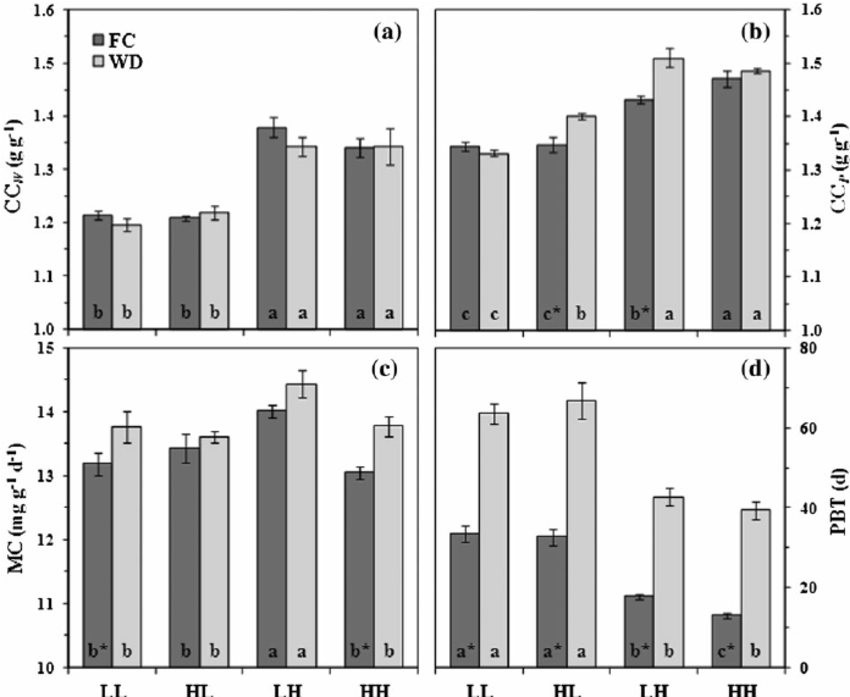
In this study, the combined effects of light and water availability on the functional relationships of the relative growth rate (RGR), leaf chemical composition, construction and maintenance costs, and benefits in terms of payback time for Coffea arabica are presented. Coffee plants were grown for 8 months in 100% or 15% full sunlight and then a four-month water shortage was implemented. Plants grown under full sunlight were also transferred to shade and vice versa. Overall, most of the traits assessed were much more responsive to the availability of light than to the water supply. Larger construction costs (12%), primarily associated with elevated phenol and alkaloid pools, were found under full sunlight. There was a positive correlation between these compounds and the RGR, the mass-based net carbon assimilation rate and the carbon isotope composition ratio, which, in turn, correlated negatively with the specific leaf area. The payback time was remarkably lower in the sun than in shade leaves and increased greatly in water-deprived plants. The differences in maintenance costs among the treatments were narrow, with no significant impact on the RGR, and there was no apparent trade-off in resource allocation between growth and defence. The current irradiance during leaf bud formation affected both the specific leaf area and leaf physiology upon transferring the plants from low to high light and vice versa. In summary, sun-grown plants fixed more carbon for growth and secondary metabolism, with the net effect of an increased RGR.

Autor(es): Nelson Facundo Rodriguez, Fábio M. DaMatta, Paulo Cézar Cavatte, Samuel C. V. Martins, Mariela Mattos da Silva

No hay productos disponibles.

No hay productos disponibles.

No hay productos disponibles.

No hay productos disponibles.